DbView Database visualization
Cardinalities
A "cardinality" represents the number of potential associations between two records, through two fields located into two distinct tables.
DbView distinguishes between four kinds of cardinalities:
- 1: "one, and only one".
- ?: "zero or one".
- *: "zero, one or more".
- +: "one or more".
Please note that these notations are inspired from the regular expressions (widely used by developers).
| Description | DbView notation | UML motation | Merise motation |
|---|---|---|---|
| One, and only one | 1 | 1 | 1,1 |
| Zero or one | ? | 0..1 | 0,1 |
| Zero, one or more | * | * | 0,n |
| One or more | + | 1..* | 1,n |
A cardinality is associated to a join.
Graphically, cardinalities are represented in a four columns grid, in the middle of an arrow that represents a joini.
Example:
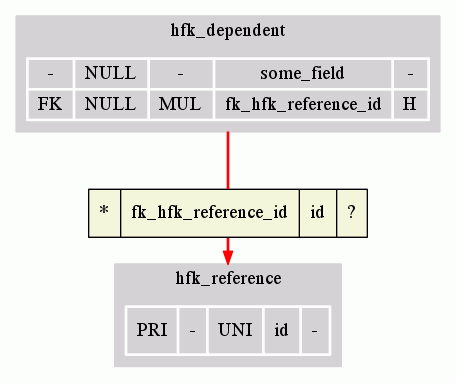
In the following text, we represent the four columns grid with the notation:
CA | @A | @B | CB
- CA: It represents the number of associations between one record "@B" (characterized by a given value of the field "B"), and some records @A (characterized by a given value of the field "A").
- CB: It represents the number of associations between one record "@A" (characterized by a given value of the field "A"), and some records @B (characterized by a given value of the field "B").
| CA | CB | Description |
|---|---|---|
| * | * |
|
| * | + |
|
| * | ? |
|
| * | 1 |
|
| + | * |
|
| + | + |
|
| + | ? |
|
| + | 1 |
|
| ? | * |
|
| ? | + |
|
| ? | ? |
|
| ? | 1 |
|
| 1 | * |
|
| 1 | + |
|
| 1 | ? |
|
| 1 | 1 |
|


